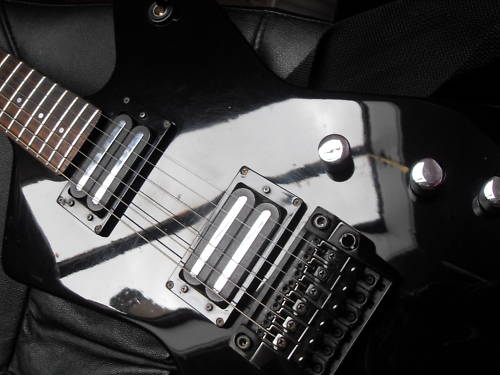
Ibanez #3 - 'RS530' marine burst

Like my other RS530, only with a fancy flamed maple top and transparent blue burst finish. This would be lovely if it weren't terribly scruffy. The frets are heavily worn, there are dinks all over the body, the finish is flaking off the headstock and the strings have worn gouges in the pickups from them being too close. It's also missing the 80s boomerang strap buttons and I've substituted some Schaller straplock buttons which I fit to most things.

It's sort of a spares donor for my other Ibanez as the hardware is in OK nick.

It would be tempting to turn it into a refinish project but I've got something simpler I want to tackle first.

Ibanez #2 - 'RS530' black

I've still got the receipt for this. Bought on 2/8/90 in the Kentish Town Music and Hifi Exchange for £115 with a snug fitting hard case. Back in the day when I used to haunt actual shops instead of eBay.

From the same stable of mid 80s Ibanez as my Destroyer, this RS530 was at the upper end of their Roadstar II line. I didn't know this at the time, it's only now with the advent of the Internet that I've a clue what this is. I do remember seeing a secondhand RS1010 Steve Lukather model once for silly money on Denmark street and commenting that this was very similar.

I couldn't afford an RG, let alone the JEM/JS1/Radius I lusted after but this was around and cheap. It became my main guitar for years until the EC29 came along. Much though I like my Destroyer it is a great big uncomfortable lump of guitar and that's kind of why I sold it.

This is packed with fancy stuff for something if its age, 24 frets, push-push coil taps and locking trem but still the Pro Rock'r rather than the Edge that came shortly afterwards. It's just a shame those frets had great runnels worn in them from it having very heavy use before I bought it. I didn't let this bother me and I soldiered on with it regardless.

The Pro Rock'r tremolo is a piece of beautiful engineering that makes a Floyd Rose look basic and agricultural. It's smoother on the hand, you can adjust individual saddle heights and the intonation adjustment is done with a fine pitch screw instead of loosen and shove. The baseplate and block are a great lump of decent cast metal so you've got the mass people try to get back by fitting big blocks to Floyds. You don't have to cut off the ball ends, you pass them down into the block and lock it off.

It's just a shame it doesn't work very well. I'm no expert but I reckon this is all because it moves on brass pins mated up against a channel in the bridge studs, instead of knife edges. So even when in perfect condition and lubricated there's tons of friction that means it doesn't return to the same point very easily.

The top-lock which locks the strings at the headstock rather than nut probably doesn't help either. I suspect both these problems were caused by Ibanez attempts to avoid paying a licence fee to Floyd Rose. Which backfired in my opinion.

So the heavy use that wore out the frets also meant the tremolo is pretty unreliable. You can use it heavily but then it needs a bit of a tweak afterwards to get it back to pitch.

I've recently had the frets dressed on this and it's transformed the guitar, I should have had this done years ago but my usual lack of trust when it comes to 'professionals' stopped me.

This sort of thing is getting genuinely collectible. Not quite as much as the 70s Ibanez or the original RGs/JEMs I couldn't afford at the time, but it's interesting to see how much they go for on eBay sometimes. How times change, when I bought this it was desperately unfashionable and definitely just 'old'. Mine is not 100% original, I replaced the 3-way switch because it failed and the jack socket is now crackly and I can see me replacing that too. Oh well it's not like it's a '59 standard.

Ibanez #1 DT350 X series Destroyer

As alluded to recently I've just got hold of my first proper guitar again. Not one the same, but the very same guitar.

This was not my first guitar but it was my first 'proper' guitar. Back when I was young guitars were pretty pricey things and teenagers would settle for anything you could find or persuade your parents to buy you that wasn't totally rubbish.

So your first guitar was probably OK-ish, the days of unplayable tat being all that was available to the skint were receding, but you probably couldn't get quite what you wanted. When I went to college I took my first guitar, which was a late 70s or early 80s Columbus Les Paul copy. My partner in guitar disaster had a Squier strat with a single humbucker. We probably should have swapped knowing what we know now.

Anyway neither of us really had what we wanted although they were eminently playable guitars, perhaps if I'd just stuck with one guitar and practiced more I'd actually be able to play. My old Les Paul might even be collectible (although not valuable) now as all manner of 'vintage' Japanese stuff is getting that way even if I'd argue lots of it is 'old' rather than 'vintage'.

So, enter the Destroyer. It was summer 1989 (I think) and I wanted to be James Hetfield. I had a reasonable summer job fixing radio pagers and some money burning a hole in my pocket. This was an Explorer, it was jet black and it had a locking tremolo. Also in black. A slab of pure metal.

At some point I decided it needed more 'oomph' and I bought a set of active electronics from one of the shops on Denmark street that gave a bass/treble cut/boost circuit and wired it in. This was my first ever guitar modding project and it must have gone OK, it's still in the guitar and working today. I had to drill a hole for the third pot and fit some replacement knobs as it originally only had two. I still have the two original knobs in one of my boxes full of guitar parts.

Eventually I decided I wanted the money for something else so I sold it to my mate Dave, who used it in bands in the NE until he sold it himself to buy a Rickenbacker 4001. I hadn't been searching for this, I just stumbled across it on eBay and bought it off a guy in Brighouse. I recognised it because of the chrome knobs and active circuit, there really can't be any other guitars around the same.

It's in much the same condition I remember. There are a few more scratches but absolutely nothing untoward. It's 25 years old now and been used so you've kind of got to expect this. It even came in the minging bass case I bodged up to fit it all those years ago with the same graffiti and GB sticker I remember.

My cup of nostalgia overfloweth.

A long time ago Andy The Pugh proposed that eBay was like a great universal lending library and that anything you sold but later wanted could simply be replaced from there. This proves it.

On dangerous ground

Back in about 1990 I bought an X-series Ibanez Destroyer. It was black and very metal. I stuck an active bass/treble boost circuit in, which was my first guitar modding project.

In about 1993 I sold this to a mate, who then sold it on later to help buy a Rickenbacker 4001. This self same guitar has just turned up on eBay, I've stolen the pictures and stuck them up here.

The really scary thing is that I was not looking for this. It found me. I have a search for old Ibanez Roadstars going on eBay but not Destroyers. A Destroyer got picked up in this search that looked similar to my old one and it made me have a quick look to see what other Destroyers were for sale. This happened the same week as the guy listed my old guitar.

Wibble.

I've checked and I'm pretty sure it's my old guitar. There is a mark in the paint I remember and I had to drill a hole for a third pot when I fitted the active circuit and swapped the knobs to chrome. These Destroyers originally came with two controls and black plastic knobs.

There is a real chance I will buy this. It won't reclaim my youth, but I kind of want it back.


Update: I seem to have just won this. ;-)

Washburn #9 - 'RS8V' white

I said I wasn't going to buy any more guitars for a bit, but this came up. In principle it's a stablemate to my EC29s, RR2V and G2V, being from around the same era. It's also from Washburn's "let's go for some stupid gimmick" department, like the EC29.

So here we have what at first glance looks like a generic 80s superstrat. Only if you look twice you'll notice the body is pretty much a PRS copy and they've just stuck a spiky headstock on. Like the PRS it's also got a set neck, which is unusual in superstrats but daftest of all is a carbon composite fretboard. This is pitch black and looks like bakelite. Oh and the usual 3-way toggle to select pickups is there but it's done with a tiny little switch you'd normally associate with a coil tap.

All in all a mishmash of generic and outlandish in the same thing. I've given it my customary clean, restring and brief setup and it's odd to play too. Despite currently having a quite high action, acoustically it has that light tinny sound I associate with the strings being far too close to the fretboard. It seems like it'll have no sustain but then it does and it's very bright sounding. Pinch harmonics seem to come really easily despite the pickups (EMG selects) not being massively overwound.

How much of this is the construction and weird fretboard I don't know, it could just be the pickups.

Anyway, when I hit 'buy it now' on this I immediately suffered a bit of buyer's remorse as I really didn't need another late 80s superstrat. However now I've got it and played it a little I'm surprised how unusual it is. Also in metallic white with that jet black fretboard it looks cool as fuck (in a retro kind of way) in my opinion.


Updates

RS8V setup
Easy win #1 & #2
Easy win #4 & #5
More monkey metal disaster
RS8V setup - finished for now

Router attack

I recently had a go at fixing one of my faulty MG440s but after putting it back together the bridge was simply too high.

I thought about shimming the neck but didn't really fancy that, so today I've taken a router to the body and inset the 'lockdown bar' so it's flush with the body. Obviously this took the finish off the guitar so I splodged a little satin black paint onto the bare wood.

With it all back together this has solved the issue with the bridge height, again I'll leave it a couple of weeks to settle before passing judgement. You can't really see the routed area as it's mostly covered by the scratchplate.

I suspect that it'll be going back on eBay if all is well. The clearance between the lockdown bar and the bridge is slightly lacking on the 'padauk' one so I may do the same to that.

Washburn #8 - 'WI64 Idol' vintage white

Hanging around on the Washburn forum has exposed me to their range and I've become interested in the Idols. These are a quite nice variant on the 'inspired by Gibson' theme most makers have somewhere in their range. It's just a shame that Washburn have now relaunched the Idol with some much more conventional Les Paul copies in it.

The original Idol comes in a genuine variety of models with the same basic silhouette, from cheapo bolt-ons with a Fender-esque hardtail, through various stop-tail models to a spiky reverse headstock Floyd Rose equipped HM model. There's even a gold-top with P90s and some semi-hollows. In principle something for everybody but I'm not sure the Idol ever really made much of an impression in the market.

This is the WI64, which is the all mahogany thin body, set neck SG-alike of the range. Most you see are the thicker body, carved top more Les Paul-esque models. I deliberately picked this one as it's a slight contrast to the large number of Les Paul copies I have. That it was cheap and came with a nice Hiscox hard case helped too.

It's astonishingly like an SG without being a straight copy. Washburn did a really good job in making their own design while keeping it familiar. This is unlike the ESP Vipers, another not-quite-SG, which I always think looks odd. The WI64 is pretty low down the range but it's a very nicely turned out example of a mass produced Korean guitar. Later production shifted to Indonesia and those guitars have a slightly worse reputation, but I doubt there's much in it.

The serial number suggests it's maybe one of the first Idols and ten years old. It's certainly been played plenty with lots of honest wear and ageing to components without it looking tired.

The hardware is decent enough, the 18:1 grovers are great and it's got the Buzz Feiten tuning system again. This will at some point force me to buy a BFTS compatible tuner as I like setting my own stuff up. The pickups are Washburn WB630s and seem adequate.

The new feature here for me is Washburn's Voice Contour Control (VCC) system in lieu of tone controls. This is a progressive coil tap arrangement but it works much better than the ones I've experienced before. From what I can gather this is because instead of simply progressively shorting out one coil it keeps both live and fades them from series to parallel using a special stacked blend pot.

This works really rather well and you don't lose as much output as you do with a standard coil tap. Although I still suspect I'll occasionally miss the tone control as even I sometimes wind the tone down a bit and VCC only makes things brighter.

It's certainly not to every players taste as there are often threads on the Washburn forum about removing VCC but some must like it as almost as many ask about fitting it to other things. I definitely don't like the way the controls have VCC stamped on them in tacky gold print though. It looks like some kind of showroom sticker that should peel off, but it's not. I guess it'd be easy enough to find some matching plain knobs.